
30+ Patent Contributions in Thermal Sciences
Our research spans tissue ablation, thermal monitoring, and hypothermia systems — reflected in peer-reviewed publications and patent contributions.
Research Papers
Selected publications demonstrating our contributions to multiphysics simulation and medical device engineering.
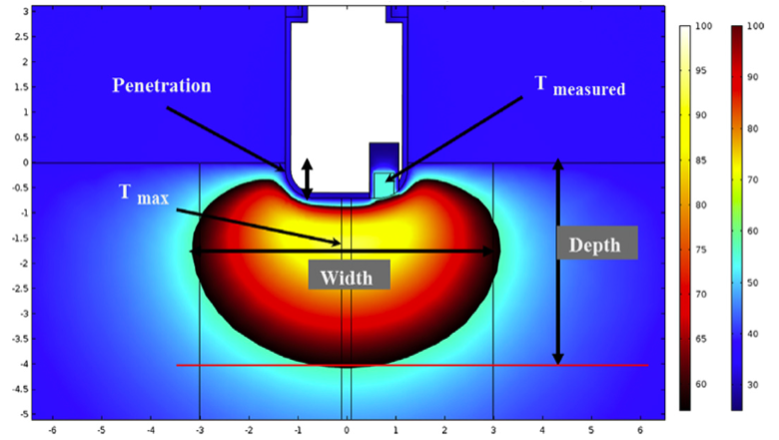
Chamber-Specific Radiofrequency Lesion Dimension Estimation Using Novel Catheter-Based Tissue Interface Temperature Sensing
Jacob S. Koruth et al. Presented a novel methodology for real-time estimation of RF lesion dimensions using catheter-based tissue thermal monitoring, enabling chamber-specific lesion assessment during cardiac ablation procedures.

An Innovative Appendage Invagination Procedure to Reduce Thrombus Formation – A Numerical Model
Ori Hazan et al. Presents a numerical model of an innovative left atrial appendage invagination procedure, evaluating its effectiveness in reducing thrombus formation through computational fluid dynamics and biomechanical analysis.
Some of our recent granted patents & PCT applications
Cryo-Assisted Irreversible Electroporation (IRE) Ablation System and Method
Inventors: Berger & Hazan
The need: To achieve effective acute tumor ablation with long lasting vaccination effect for optimal patient treatment, by combining cryo-assisted PFA technology with Immunotherapy.
A brief: A novel hybrid technology that combines subzero temperatures and IRE in ablation needles, allowing accurate control of the cells' membrane permeability in-vivo, for a long duration. This technology is designed to optimize solid tumor ablation, increase efficacy and could amplify the immunotherapy agent's effect.
Catheter with jet impingement cold thermoelectric module
Inventors: Berger & Hazan
The need: Recent pilot clinical study of selective brain cooling with Intra-Arterial infusion of cold saline combined with thrombectomy therapy in acute ischemic stroke patients seems feasible and safe. Still, common hazards preclude its deployment. A technology without saline infusion is needed for safer, more effective hypothermal treatment for stroke patients.
A brief: A technology developed for Cryo-assisted IRE ablation, based on thermoelectric micro-devices embedded in a catheter for introduction into a therapy site for freezing human tissue or cooling blood flow at the therapy site.
Monitoring tissue temperature while using an irrigated catheter
Co-Inventors: Berger & Hazan, a collaboration with Biosense Webster (a Johnson & Johnson company)
The need: Lesion dimension prediction is crucial in tissue ablation to ensure effective treatment of conditions such as atrial fibrillation, by continuous monitoring of the lesion during the procedure, to achieve a durable conduction block. This could prevent complications and improve treatment outcomes.
A brief: A method, consisting of modeling physical parameters representative of a probe in proximity to body tissue during an ablation procedure performed by the probe. In response to the modeling, the method includes generating calculated ablative values for the ablation stage and compares measured values with the calculated values, for a real time lesion assessment.
Using a predetermined ablation-current profile
Co-Inventors: Berger & Hazan, a collaboration with Biosense Webster (a Johnson & Johnson company)
The need: To perform a maximal lesion size in a minimal ablation time duration (a fast application reduces the chance of catheter movement from the ablated site as a result of the heart muscle motion).
A brief: A system that includes a current source generator and a processor. The processor is configured to drive the current source generator to supply, for application to tissue of a subject, an electric current having an amplitude that varies in accordance with a predefined function of time, such that the amplitude initially monotonically increases to a maximum value.
Medical probe for navigating small diameter blood vessel
Co-Inventors: Berger, a collaboration with Biosense Webster (a Johnson & Johnson company)
The need: The ligament of Marshall (LOM), located on the epicardium between the left atrial appendage and the left pulmonary veins, is often a source of paroxysmal atrial fibrillation (AF). This disrupts the normal cardiac cycle and causes asynchronous rhythm. By selectively ablating cardiac tissue by application of energy via a catheter, it is sometimes possible to cease or modify the propagation of unwanted electrical signals from one portion of the heart to another.
A brief: A medical probe that includes an elongated shaft, a guidewire, coils, and electrodes and is dimensioned to be inserted into a vein of Marshall. Each electrode is designed to sense anatomical signals and convey ablation energy to a target tissue region proximal the vein of Marshall.
Controlling cardiac ablation using blood electrical conductivity
Co-Inventors: Berger & Hazan, a collaboration with Biosense Webster (a Johnson & Johnson company)
The need: When performing ablation procedures, the depth and size of lesion varies by patient. To accommodate the differences between patients, lesion parameters are adjusted based on the individual patient. However, it is difficult to predict the parameters of lesion per patient. Further difficulties in lesion size prediction are due to the range of blood conductivity in humans being very wide, which significantly affects the amount of energy that flows to the tissue during RF ablation.
A brief: Methods and systems provide lesion size assessments to be ablated into tissue, such as cardiac tissue. The lesion size assessments are based on parameters including blood conductivity, hot-spot-temperature, catheter tip temperature, and current data of the Radiofrequency (RF) ablation energy being used, such as power, duration, temperature, irrigation and contact force.
Planar Multi-electrode catheter
Co-Inventors: Berger, a collaboration with Biosense Webster (a Johnson & Johnson company)
The need: More recently, it has been found that by mapping the electrical properties of the endocardium, and selectively ablating cardiac tissue by application of energy with the same device, at the same targeted site, it is possible to cease or modify the propagation of unwanted electrical signals from one portion of the heart to another with greater efficacy.
A brief: Catheters are presented herein having planar end effectors of various configurations, generally providing a two-sided and multi-layered platform for electrodes and sensors. This platform facilitates positioning of electrodes on either side (including both sides) of the end effector in a variety of spacings and facilitates ultra-tight electrode spacing and/or a large area electrode.
Neuroprotection apparatus
Inventors: Berger & Hazan
The need: A non-invasive thermal brain mapping is needed for real time and continuous stroke monitoring and for local brain hypothermia monitoring. Among potential intended uses: early diagnosis / prediction of stroke / ischemia among Neuro-ICU patients, "in the field" as well as during ambulance transport. This technology will provide physicians with prompt imaging, allowing for early diagnostics, intervention, and potential prevention of complications.
A brief: Provided is a neuroprotection apparatus including a scalp temperature measurement acquisition device for acquiring scalp temperature measurements at a plurality of locations on a patient's scalp during an induced hypothermia or ischemia and a neuroprotection processor for processing the scalp temperature measurements for determining real time patient temperature information.